Most branches run the same pattern every day. The first two hours after opening fill with customers. The mid-morning rush gives way to a quiet stretch. The hours before closing are sparse, sometimes completely empty. Staffing costs, rent, and operational overhead stay the same throughout.
This cost structure creates a straightforward problem. The operation pays for eight hours. Productive activity concentrates in two or three. The gap between what the branch costs and what it produces is not a staffing gap. It is a demand distribution gap.
Appointment scheduling addresses that gap by giving branches a mechanism to influence when customers arrive. The five benefits below explain how that mechanism works in practice, and why the effects reach further than most managers expect.
Your branch is staffed for eight hours. Your customers use two of them.
The 5 Benefits at a Glance
- Staff and facility capacity stop going to waste
- Demand distributes across the full working day
- Wait times drop for everyone
- The day becomes predictable before it starts
- Customer experience improves on both sides
Staff and Facility Capacity Stop Going to Waste
A branch that runs from 8am to 4pm carries eight hours of staffing cost. If meaningful customer activity concentrates in two or three of those hours, the remaining time is a direct operational loss. Staff are present and paid. Space stays open and occupied. Equipment runs all day. The cost is constant. The output is not.
The waste is structural, not operational. Front-line staff cannot solve it by working harder during quiet hours. Managers cannot solve it by adjusting shift patterns. The problem exists because customer arrival behavior, left unmanaged, does not match the spread of operating hours. Appointment scheduling is the mechanism that changes customer arrival behavior.
By opening off-peak slots for booking, a branch gives customers a reason to arrive at different times. Quiet hours begin to fill. The ratio of productive hours to total hours improves. The same staff, the same space, and the same operational cost start producing more consistent output across the full day.
Demand Distributes Across the Full Working Day
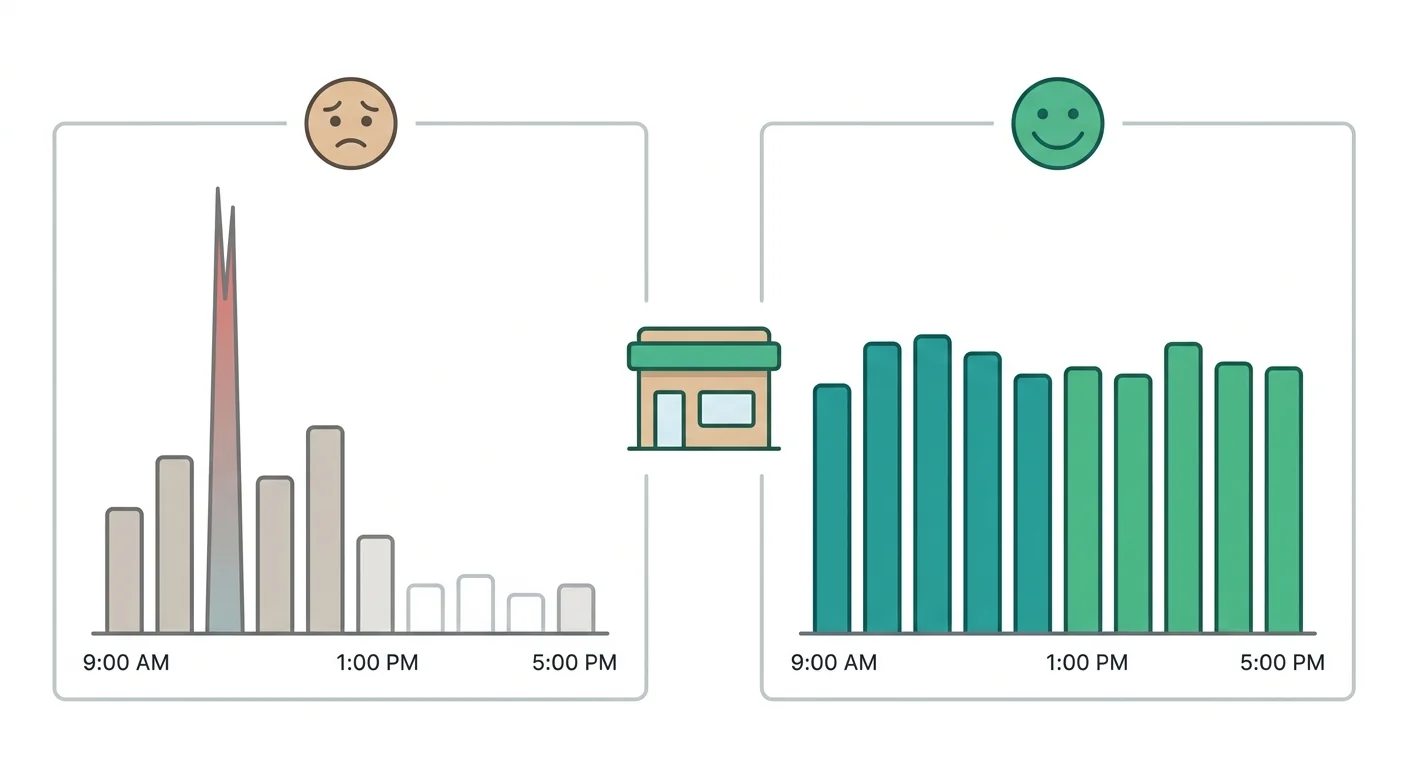
Without any intervention, customers cluster in the same arrival windows. Opening hour is convenient. The post-lunch period is habitual. Nobody coordinates, but everyone ends up arriving at the same time. The result is a compressed demand curve: high volume for two hours, near-zero for the rest.
Appointment scheduling restructures that curve. Off-peak slots become available and bookable. A customer who would have joined the 10am rush can instead book a 2pm slot. He gets a confirmed time. The branch gets a customer in a period that was previously empty. Both sides benefit from an exchange that would not have happened otherwise.
The shift is gradual. Walk-in behavior persists, and a well-designed system keeps it fully intact. Moving a fraction of peak-hour arrivals to off-peak slots is enough to narrow the gap between the busiest hour and the quietest. Over time, the day runs at a more consistent pace.
Wait Times Drop for Everyone
Wait time reduction is the benefit customers notice first, but the mechanism matters. It works differently for appointment holders and walk-in customers, and both groups come out ahead.
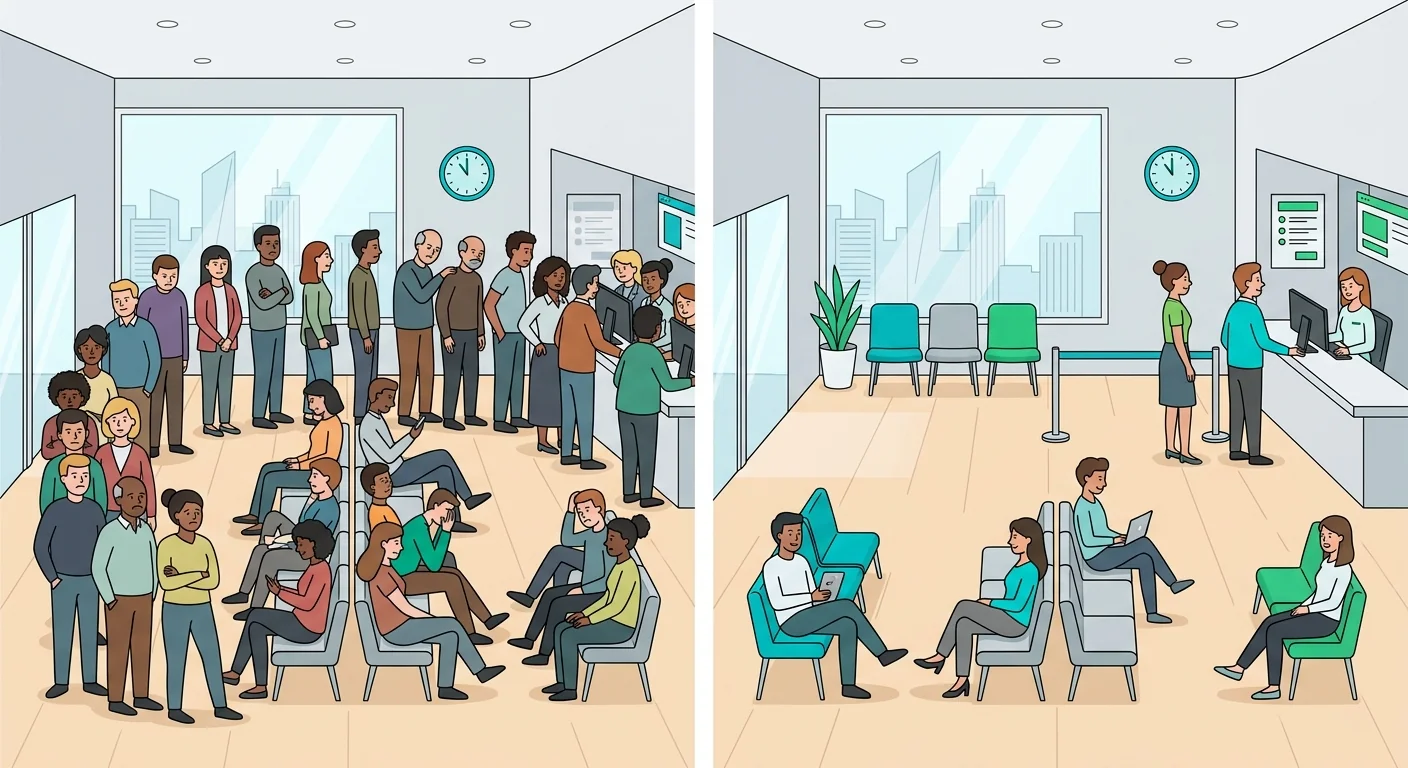
Appointment holders benefit directly. They arrive at a confirmed time and join the queue at the correct priority. The uncertainty of showing up without knowing how long the wait will be disappears. A fifteen-minute wait feels different when the customer chose it in advance versus encountering it unexpectedly at the door.
Walk-in customers benefit indirectly. When appointment scheduling moves some of the peak-hour demand to off-peak slots, the peak itself becomes less intense. Fewer customers arrive at 10am. The queue is shorter. Walk-in wait times fall, without those customers ever interacting with the booking system.
This matters for branch managers who worry that introducing appointments will frustrate walk-in customers. The concern is understandable, but the data runs in the opposite direction. Walk-in customers in a hybrid system typically wait less than they did before appointments arrived, because the peak they used to compete with is smaller.
The Day Becomes Predictable Before It Starts
Without appointment data, a branch begins each day with limited information. The manager knows from experience when it tends to get busy, but not how many customers to expect, and not which services will drive demand. Staffing decisions rely on pattern recognition and instinct.
Appointment data changes the starting position. Consider what happens the day before a typically busy morning. Without appointments, the manager prepares based on last week’s results and a general sense of what to expect. With appointments, the manager sees that 34 customers have bookings between 9am and 11am and only 8 have booked for the afternoon. That is actionable information. Staff assignments, break schedules, and coverage decisions can shift to match what the data shows rather than what experience suggests.
The predictability builds over time. Consistent booking patterns become visible across weeks. If a particular service draws most of its appointments to the morning, that pattern informs how managers deploy staff on an ongoing basis. Planning moves from assumptions to evidence.
Customer Experience Improves on Both Sides
The experience benefit from appointment scheduling applies to customers who book and to those who arrive as walk-ins.
Appointment holders gain control over their visit. They choose when to come, they know what to expect, and they arrive with a confirmed place in the queue. For customers with limited availability during working hours, that predictability changes the relationship with the branch from unpredictable to manageable.
Walk-in customers gain shorter waits as a side effect of better demand distribution. They did not book, and the branch does not penalize them for it. The queue they join at 11am is shorter than it would have been because some of the 11am demand moved to the afternoon.
For branch managers and regional leaders, both outcomes are measurable. Satisfaction scores for appointment holders tend to improve. Walk-in wait times fall. These numbers become the evidence that justifies the investment and supports the case for expanding the system to additional locations.
Key Takeaways: Benefits of Appointment Scheduling for Branches
- The primary financial benefit is capacity utilization: the same staffing and facility cost produces more consistent output when demand spreads across the full working day.
- Walk-in service continues uninterrupted. Walk-in customers benefit from reduced peak pressure even without ever interacting with the booking system.
- Appointment data gives managers visibility before the day starts, turning staffing decisions from guesswork into evidence-based planning.
- Customer experience improves for both groups: certainty for appointment holders, shorter waits for walk-ins.
- Partial adoption is enough to shift the demand curve and begin producing measurable results.
No. A branch-integrated scheduling system runs appointments and walk-ins through the same queue simultaneously. Appointment holders receive a reserved slot; walk-in customers continue arriving and joining the live queue as they always have. The goal of appointment scheduling is to distribute demand more evenly across the day, not to gate access to the branch behind a booking requirement.
The most visible changes tend to appear within the first few weeks, as booking behavior begins to shift some peak-hour demand to off-peak slots. The full benefit takes longer to emerge. Consistent patterns in booking data become clear after four to six weeks of operation, and staff and managers typically adjust their planning habits over one to two months as they gain confidence in the data.
Adoption rates vary by branch type, customer profile, and how actively the branch promotes the booking option. In most service environments, partial adoption is the norm rather than full adoption, and partial adoption is enough to produce measurable results. Moving 20 to 30 percent of peak-hour demand to off-peak slots is sufficient to reduce wait times and improve capacity utilization across the day.
Yes, and high walk-in volume is precisely the context where it adds the most value. Branches with high walk-in traffic tend to have the most compressed demand curves, with intense peaks and long quiet periods. Appointment scheduling gives those branches a mechanism to smooth the curve without removing walk-in access. Walk-in customers benefit from reduced peak pressure even if they never use the booking system.
At the operational level, appointment data gives managers a view of expected demand before the day starts: how many customers are booked, at what times, and for which service types. At the planning level, booking patterns across weeks reveal consistent trends in service demand, arrival timing, and capacity gaps. Managers use this data to make staffing decisions based on evidence rather than experience alone.
It depends on the system. Branch-integrated scheduling platforms include queue integration as a core feature, not an add-on. The appointment list feeds directly into the live queue, so appointment holders and walk-in customers join the same line through a single interface. Standalone booking tools and most CRM scheduling modules lack this integration and require staff to manage two separate systems manually.
Waqtak is a cloud-based queue management system built for multi-branch service organizations.

Alawneh Exchange Partners With Waqtak to Take the Wait Out of the Branch Visit
Waqtak and Alawneh Exchange have partnered to bring digital queue and appointment services to Alawneh’s customers across the…
Your Busiest Two Hours Are as Expensive as Your Quietest Six
At 10:30 in the morning, the waiting area is standing room only. Numbers have been called, customers are…
How to Choose an Appointment Scheduling System for Multiple Branches
Not every appointment scheduling system solves the same problem. A system built for a freelance consultant and a…
Want to see how this works in practice?
Book a personalized demo and we will walk you through how Waqtak closes these blind spots for an operation like yours.
Book a Demo