Walk into most branches at 10am and you will find a packed waiting area, staff working at full capacity, and customers who arrived thirty minutes ago still waiting to be seen. Walk in at 2pm and the same branch is quiet. The same staff are there. The same systems are running. But the workload is gone.
This is not a staffing problem. It is a demand distribution problem. And it happens in almost every branch that runs entirely on walk-ins.
Your branch is staffed for eight hours. Your customers use two of them.
An appointment scheduling system for branches is what changes this. It does not replace walk-in customers. Instead, it gives branches a way to steer a portion of demand into the hours that would otherwise go to waste, so the workload spreads across the full day instead of collapsing into a two-hour peak.
What is an Appointment Scheduling System for Branches at a Glance
- Lets customers pre-book a specific service slot at a specific branch, in advance
- Redistributes demand from peak hours into quieter parts of the day
- Works alongside walk-in customers, not instead of them
- Sends automated reminders to reduce no-shows
- Feeds booked appointments into the same queue as walk-ins
- Gives staff advance visibility into who is arriving and what they need
What Does an Appointment Scheduling System for Branches Do?
An appointment scheduling system for branches allows customers to reserve a specific time slot for a service at a branch location, in advance and through a channel of their choice, whether a website, a mobile app, or a messaging platform.
Unlike a general calendar booking tool, an appointment scheduling system built for branch operations is designed to handle the specific complexity of multi-location service delivery: multiple branches, multiple service types with different durations, staff availability that varies by location, and a walk-in customer base that does not disappear just because appointments exist.
The output is a structured daily schedule that the branch manager can see before the day begins. Instead of opening the doors and waiting to see what arrives, the branch knows its expected volume, its service breakdown, and its quiet windows before the first customer walks in.
What Problem Does an Appointment Scheduling System Solve?
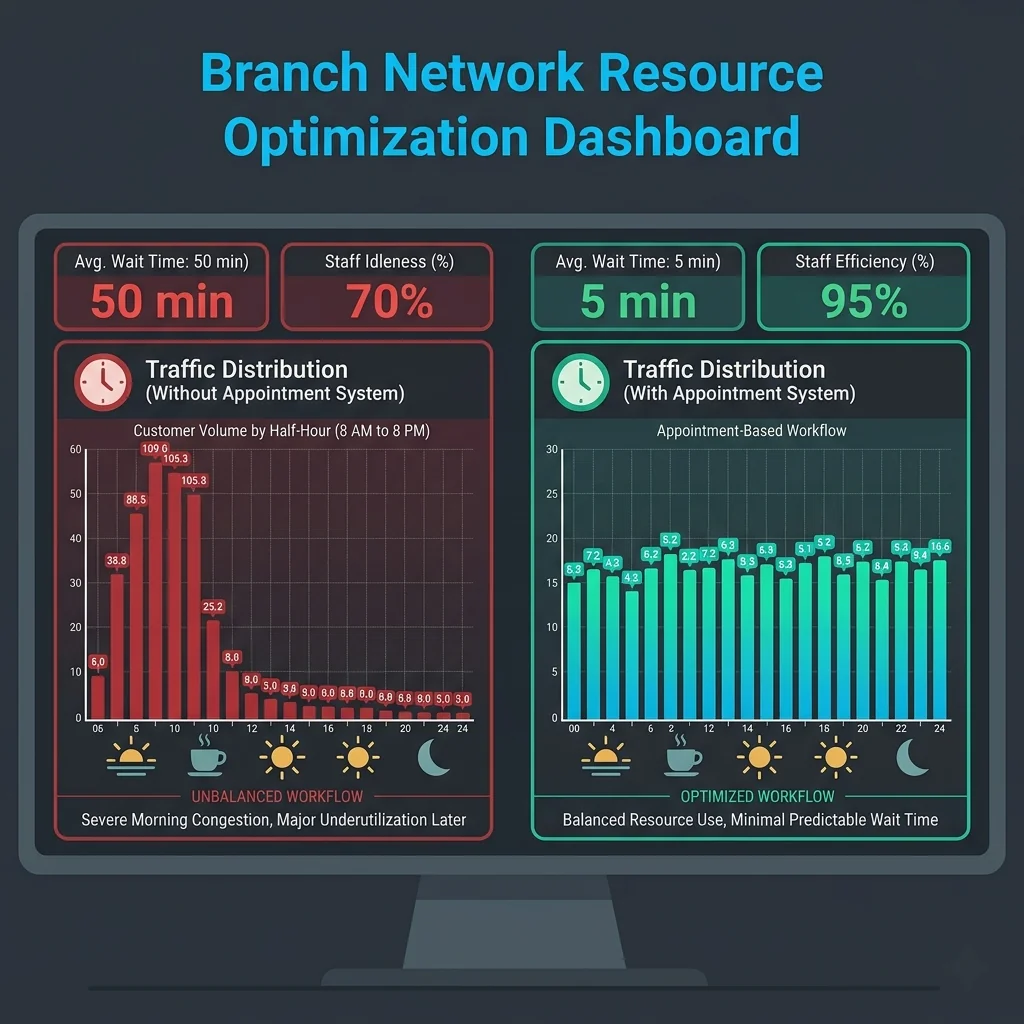
The core problem appointment scheduling solves is not long queues. It is uneven demand.
In most branch operations, customer arrivals follow a predictable but unmanageable pattern. A significant share of daily volume arrives in a two to three hour window, typically mid-morning. The rest of the day is underutilized. The branch is fully staffed, fully operational, and largely idle for the hours outside that peak.
This creates two problems that compound each other. During the peak, service quality drops because demand exceeds capacity. Outside the peak, operational cost remains constant while output falls. The branch is paying for eight hours of operation but delivering at full capacity for two or three of them.
An appointment scheduling system addresses this by making it possible to redirect demand. When customers can see available time slots and book in advance, a portion of them will choose off-peak slots, not because they are asked to, but because the option is available and convenient. Over time, this shifts demand from the peak into the hours that were previously going unused.
The result is not just shorter queues during busy hours. It is a fundamentally more even distribution of workload across the entire working day. For more on how that distribution affects branch performance, see What is a Queue Management System and how queue management handles the walk-in side of the same equation.
How Does an Appointment Scheduling System for Branches Work?
A branch appointment scheduling system operates across three stages: booking, preparation, and arrival.
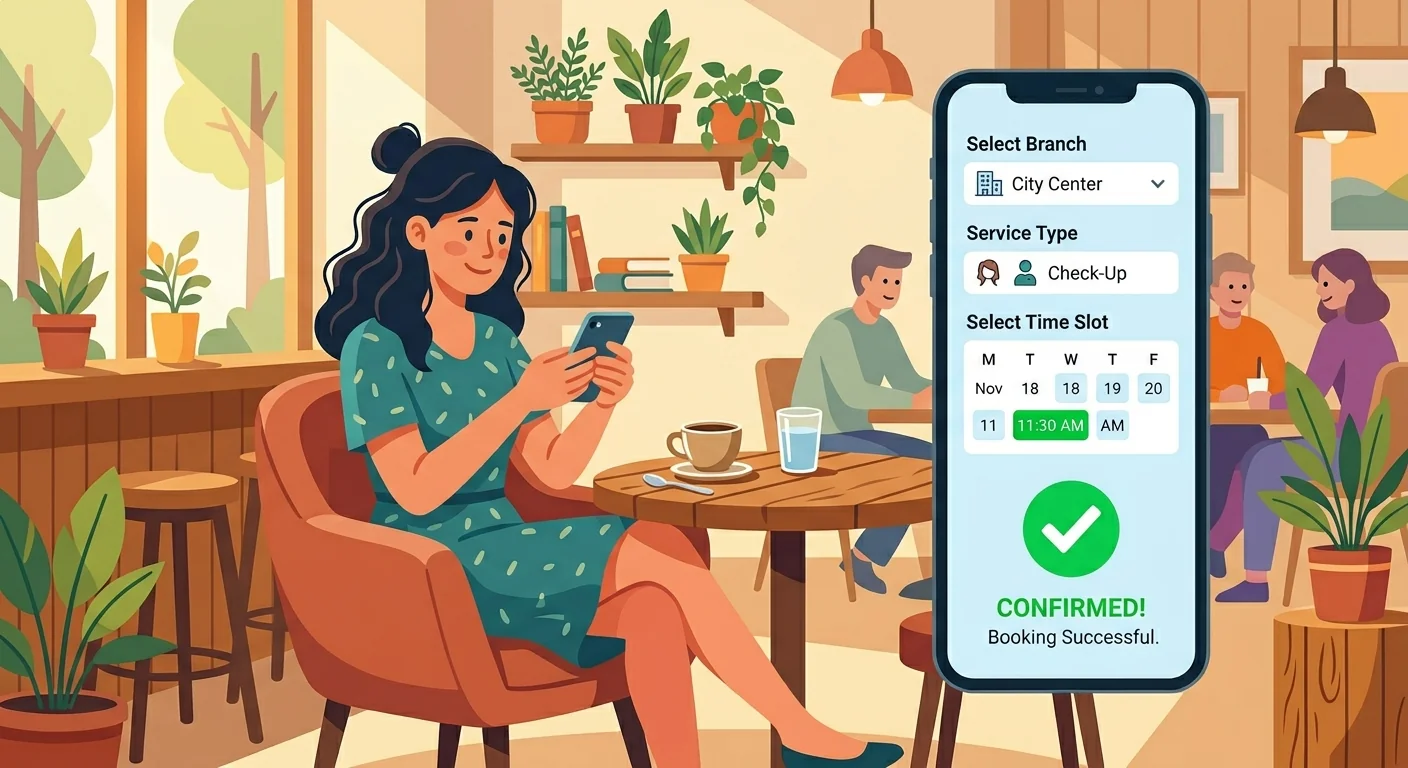
Booking. The customer accesses a branded booking interface, through a web link, a mobile app, or a messaging channel, and selects their service, their preferred branch, and an available time slot. The system assigns the slot based on service duration and staff availability and confirms the booking immediately via SMS or email.
Preparation. Before the customer arrives, the system sends automated reminders at configurable intervals, typically 24 hours and 2 hours before the appointment. If the customer needs to cancel or reschedule, they can do so directly from the reminder message. The freed slot returns to the available pool automatically. Staff can see upcoming appointments and the service details attached to each one before the customer walks in.
Arrival. When the customer arrives, they check in at a kiosk or through the branch’s system. The appointment is confirmed and the customer enters the queue at a priority position that reflects their pre-booked slot. Walk-in customers are served from the same queue, with configurable priority weighting that keeps both groups moving.
How Do Appointments and Walk-Ins Work Together?
This is the question most branch managers ask first, and it is the right one to ask.
An appointment scheduling system for branches does not replace walk-in customers. In most branch environments, walk-ins represent a significant share of daily volume and will continue to do so regardless of what booking options are available. A system that cannot handle both is not a system that works in practice.
In a well-designed appointment scheduling system, booked appointments and walk-in arrivals feed into a single unified queue. Staff work from one interface. Customers experience one consistent service flow. The difference is that appointment customers arrive at a known time and receive priority placement in the queue for that slot, while walk-in customers join at their natural position and are served in order.
The effect over time is that appointments gradually shift a portion of demand away from peak hours, which reduces the walk-in queue during those hours as well. Walk-in customers benefit from an appointment scheduling system even if they never book in advance, because the customers who do book are no longer all arriving at the same time.
Key Takeaways: What is an Appointment Scheduling System for Branches?
An appointment scheduling system for branches is a demand distribution tool. Its primary function is not to add a booking feature, it is to give branches control over when their workload arrives, so the full working day can be used productively rather than concentrated into a two-hour peak.
| Concept | What It Means in Practice |
|---|---|
| The core problem | Demand is concentrated in 2-3 hours. The rest of the day is underused. |
| What the system does | Redirects a portion of demand into quieter hours through advance booking. |
| Walk-ins | Not replaced. Served alongside appointments in a single unified queue. |
| Staff benefit | Know who is arriving and what they need before they walk through the door. |
| No-shows | Reduced by automated reminders. Cancelled slots return to the available pool. |
| The outcome | A branch that runs at a sustainable pace across the full day, not just the peak. |
A queue management system handles customers after they arrive, organizing walk-ins, reducing perceived wait time, and managing service flow at the branch level. An appointment scheduling system works before arrival, giving customers a way to pre-book a time slot so the branch knows who is coming and when. The two systems are designed to work together: appointments feed into the queue alongside walk-ins, and the queue management system handles both from a single interface.
Yes. An appointment scheduling system for branches is designed to operate in hybrid environments where walk-ins remain the majority. The system does not require all customers to book in advance, it only requires that some of them do. Even a 20-30% shift to pre-booked appointments is enough to meaningfully reduce peak-hour congestion and distribute workload more evenly across the day.
Customers can book through a web-based booking page accessible from any device, a mobile app, or a messaging platform. In GCC markets, WhatsApp-based booking is particularly effective, as it allows customers to book, receive confirmations, and manage their appointments through a channel they already use daily. All booking methods connect to the same system, so staff see a single consolidated view regardless of how the customer booked.
When a customer misses their appointment, the system marks the slot as a no-show and automatically releases it for rebooking. Automated reminders sent via SMS or email before the appointment, typically 24 hours and 2 hours in advance, significantly reduce no-show rates. Customers can cancel or reschedule directly from the reminder message, which returns the slot to the available pool without any manual intervention from branch staff.
Yes, and this is one of the primary reasons branch networks use purpose-built appointment scheduling systems rather than single-location booking tools. A multi-branch appointment scheduling system allows customers to select their preferred location at the time of booking, gives branch managers visibility into their own location’s schedule, and gives regional managers a consolidated view across all branches. Staff availability and service duration are configured per branch, so each location operates independently within the same system.
Deployment time depends on the platform and the complexity of your service catalog. Systems built specifically for branch operations typically go live within days to a few weeks, since the core configuration, branches, services, staff availability, time slots, follows a standard setup process. The booking page can be branded and published quickly, and staff training is minimal because the interface is designed for daily operational use, not technical administration.
Waqtak is a cloud-based queue management system built for multi-branch service organizations.

Alawneh Exchange Partners With Waqtak to Take the Wait Out of the Branch Visit
Waqtak and Alawneh Exchange have partnered to bring digital queue and appointment services to Alawneh’s customers across the…
Your Busiest Two Hours Are as Expensive as Your Quietest Six
At 10:30 in the morning, the waiting area is standing room only. Numbers have been called, customers are…
How to Choose an Appointment Scheduling System for Multiple Branches
Not every appointment scheduling system solves the same problem. A system built for a freelance consultant and a…
Want to see how this works in practice?
Book a personalized demo and we will walk you through how Waqtak closes these blind spots for an operation like yours.
Book a Demo