Customer feedback is not scarce. Every customer who visits a branch forms an opinion: the wait, the staff, the outcome of the interaction. Most of them never share that opinion with the branch directly. Customer feedback management is the discipline that captures it systematically before it disappears.
Customer feedback management is the practice of systematically collecting, organizing, and acting on that input. For branch operations, it is the difference between knowing what customers think and guessing.
Most customers who had a bad experience at your branch did not tell you. They told someone else.
At a Glance
- A customer feedback management system covers the full cycle from collection to action, not just the collection stage
- It captures feedback across multiple channels and service touchpoints
- It turns individual responses into patterns that managers can act on
- It alerts managers to problems before they become trends
- Without it, the only feedback that reaches management comes from the minority of customers who choose to complain
What is Customer Feedback Management?
Customer feedback management (CFM) is the structured process of collecting customer input, organizing it at scale, identifying patterns, and routing insights to the people who can act on them. It covers the tools, workflows, and practices that turn individual customer opinions into operational information.
In a branch context, CFM operates across the customer journey. Feedback arrives at the point of service through a kiosk at the counter, immediately after the visit through an SMS survey, and at regular intervals through scheduled satisfaction surveys. The goal is to capture a representative picture of customer sentiment across all visits, not just the interactions where something went notably right or wrong.
The distinction between a one-off survey and customer feedback management is the difference between a snapshot and a continuous signal. A satisfaction survey sent once a quarter tells you what a sample of customers thought on a specific day. A CFM system tells you what customers experience every day, how that experience changes over time, and where it varies across your network.
CFM is also distinct from complaint management. Complaint management handles customers who took the initiative to raise a specific issue. Customer feedback management captures the full range of customer experience, including the customers who had a poor experience, said nothing to the branch, and left without indicating anything was wrong.
What Does a CFM System Do?
A CFM system handles the mechanics of the feedback cycle across four stages.
Collection comes first. The system presents customers with a feedback prompt at the right moment, through the right channel, in a format that produces usable responses. Timing matters: a prompt delivered within minutes of a service interaction captures a more accurate impression than a survey sent days later.
Aggregation follows. The system consolidates responses from multiple branches and channels into a single view. Individual responses matter less than the patterns they form. A CFM system makes those patterns visible rather than leaving managers to identify them manually from a growing list of separate responses.
Analysis turns those patterns into operational signal. The system identifies trends, flags anomalies, and surfaces the metrics that matter to branch managers and regional leaders, including satisfaction scores over time, comparison data across locations, and alerts when scores fall below a defined threshold.
Routing delivers the right information to the right person. A low score at a specific branch triggers an alert to the branch manager. A pattern emerging across multiple locations surfaces in the regional dashboard. The feedback reaches the people who can act on it, at the moment they can still act on it.
What Types of Feedback Does a Customer Feedback Management System Collect?
CFM systems collect several types of input, each serving a different analytical purpose. The combination of measurement types matters: a single metric captures part of the picture, while multiple types together reveal patterns that no single question can surface.
- CSAT (Customer Satisfaction Score): A direct rating of a specific interaction, usually on a 1-5 scale. Fast to complete and easy to compare across branches and over time.
- NPS (Net Promoter Score): Measures the likelihood of a customer recommending the branch to others. On a 0-10 scale, responses fall into Promoters (9-10), Passives (7-8), and Detractors (0-6). Widely used as a loyalty and churn indicator.
- Service-specific ratings: Ratings tied to a particular service type, staff interaction, or touchpoint rather than the overall visit. Useful for identifying where in the service journey satisfaction drops.
- Open-ended comments: Unstructured text responses that provide context behind the numbers. Harder to analyze at scale but often the most specific and actionable input for frontline managers.
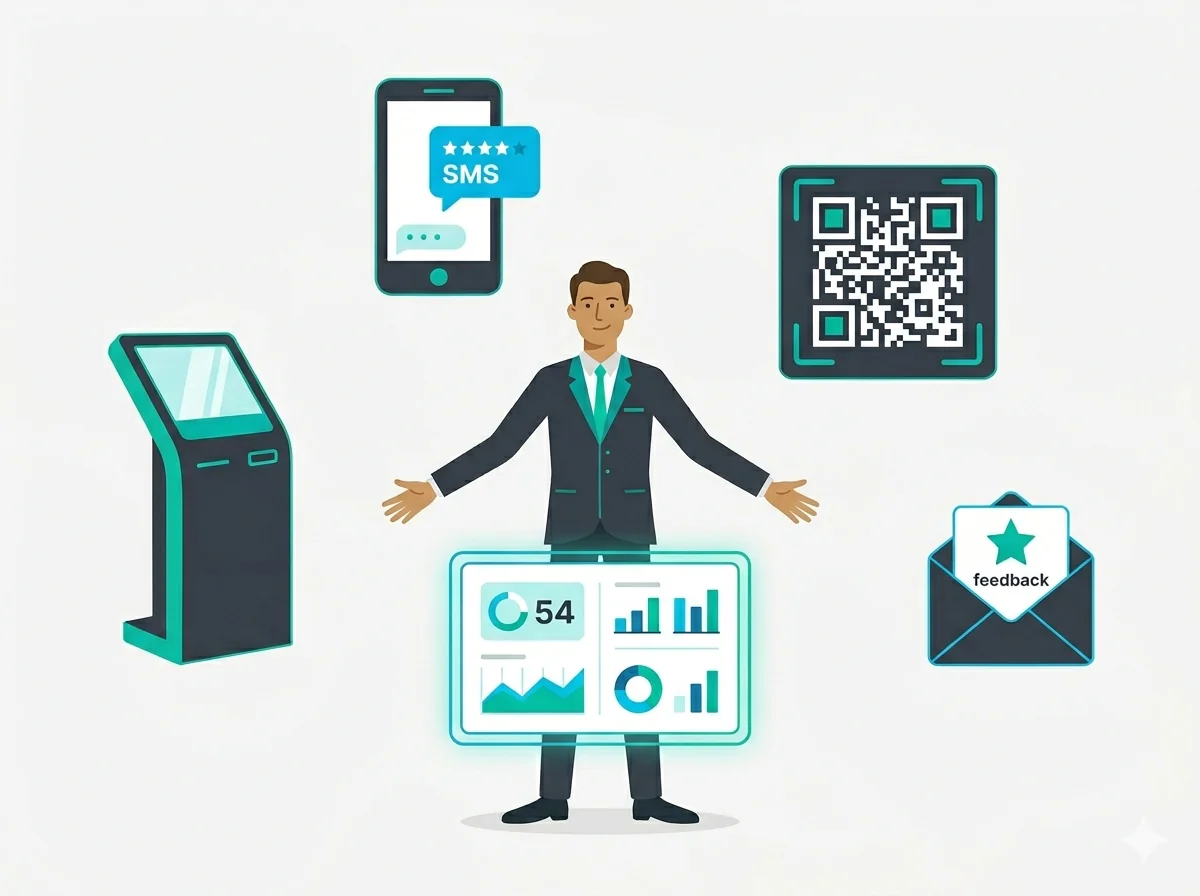
Effective CFM systems collect across multiple channels — kiosk, SMS, QR code, mobile app, email — to reach different customer segments. A customer who would not stop at a counter kiosk will sometimes respond to an SMS sent after leaving the branch. Channel variety increases response rates and reduces the sampling bias that comes from capturing only the customers willing to engage at a specific moment.
What Happens to Feedback After Collection?
Collection is the first stage. The operational value of a CFM system depends on what happens next.
Responses flow into a central dashboard where branch managers and regional leaders view scores, trends, and individual comments. Automated alerts notify managers when satisfaction scores fall below a defined threshold or when a specific complaint type appears repeatedly at a location. Trend reports show whether satisfaction at a branch is improving, declining, or stable across weeks and months.
The speed of the feedback loop matters as much as the data it produces. A customer satisfaction issue surfacing in a weekly report reaches management seven days after the experience. The same issue identified through an automated alert reaches management within minutes. For branch operations where service quality can shift quickly during peak hours, that difference in response time is the difference between containing a problem and compounding it.
For multi-branch operations, the aggregation layer provides the comparison data that individual branches cannot generate alone. How does Branch A’s satisfaction score compare to Branch B’s this month? Which location shows consistent improvement? Which service type receives low ratings across all branches, pointing to a systemic issue rather than a local one? According to McKinsey, organizations that systematically act on customer feedback outperform those that collect it without closing the loop. Collection without action is not customer feedback management. It is record keeping.
What Does a Branch Look Like Without Customer Feedback Management?
Without a CFM system, a branch operation relies on incomplete signals to understand how customers experience the service.
Formal complaints represent a small fraction of dissatisfied customers. Most customers who have a poor experience do not raise it with the branch. They reduce their visits, switch to a competitor, or share their experience informally with others. The branch has no record of any of this. The gap between actual customer sentiment and the feedback that reaches management grows larger as the operation scales.
Staff observations fill part of the gap. A manager who walks the floor regularly notices tension, long queues, and frustrated customers. Those observations are valuable. They are also inconsistent, subjective, and impossible to aggregate across fifteen locations. What a manager witnesses at one branch on one morning is not a reliable picture of the experience across the full network.
Without systematic feedback, a branch operation has no baseline to measure satisfaction against, no early warning system for declining service quality, and no way to distinguish between an isolated problem at one location and a pattern that spans the entire network. Issues that a CFM system would surface within days remain invisible until they appear as customer churn months later.

Key Takeaways: What is Customer Feedback Management?
- Customer feedback management is the structured process of collecting, organizing, and acting on customer input across all service interactions. It is not the same as complaint management.
- A CFM system captures the full spectrum of customer sentiment, including the majority of dissatisfied customers who said nothing directly to the branch.
- Modern systems collect across multiple channels, aggregate responses from all locations, and alert managers to problems in near real time.
- For multi-branch operations, CFM provides the comparison layer that individual branch observation cannot: which locations are improving, which are declining, and where problems are systemic rather than local.
- Without a CFM system, the feedback that reaches management consists almost entirely of outliers. The silent majority of dissatisfied customers, and the patterns they represent, stay invisible.
Complaint management handles customers who take the initiative to raise a specific issue. It captures the minority who felt strongly enough to say something. Customer feedback management captures the full spectrum of customer experience, including the majority who had a poor interaction and said nothing directly to the branch. Customer feedback management is proactive and systematic. Complaint management is reactive and selective. A branch that relies only on complaints is measuring the loudest signal, not the most representative one.
Modern customer feedback management systems use short, low-friction prompts: a one or two question rating at the exit kiosk, an SMS sent within minutes of the visit, or a QR code on the service receipt. The interaction takes under thirty seconds for the customer. The timing is what matters most — prompts delivered immediately after the service interaction capture a more accurate impression than surveys sent hours or days later.
Response rates vary by channel and customer profile. In-branch kiosks typically see engagement from 10 to 20 percent of customers. SMS surveys sent shortly after the visit tend to perform better, often reaching 20 to 35 percent depending on the message format and timing. Response rates improve when the prompt is short, the channel is convenient, and customers receive it while the experience is still fresh. Even at 15 percent, a customer feedback management system generates enough data across a multi-branch network to identify meaningful patterns.
Yes. A branch-integrated customer feedback management system collects feedback regardless of how the customer arrived. Walk-in customers can receive a prompt at the exit kiosk or via SMS after the visit. Appointment holders can receive a post-visit survey through the same channel they used to book. The system links the feedback to the interaction type, so branch managers can compare satisfaction scores between appointment and walk-in customers and identify whether the experience differs between the two groups.
From a single branch, customer feedback management starts producing useful data relatively quickly. The real value multiplies with scale. A multi-branch operation gains the ability to compare satisfaction across locations, identify which branches are improving and which are declining, and distinguish between local problems and systemic ones. For a regional manager responsible for ten or more branches, the comparison layer is what makes customer feedback management operationally significant rather than just informative.
In a properly configured customer feedback management system, near real time. A customer who rates their experience poorly at 10am can trigger a manager alert by 10:15am. The speed depends on how the alert thresholds are configured: most systems allow managers to set a minimum score that triggers an immediate notification. This response speed matters in service environments where the same issue can affect multiple customers during a busy period if left unaddressed.
Waqtak is a cloud-based queue management system built for multi-branch service organizations.

How to Choose a Customer Feedback Solution
The market for customer feedback tools is crowded. Survey platforms, NPS tools, exit kiosk vendors, CRM-integrated feedback modules…

The Benefits of Customer Feedback Management Systems
Most branches already collect some form of customer feedback. A comment box at the exit. A link in…
Want to see how this works in practice?
Book a personalized demo and we will walk you through how Waqtak closes these blind spots for an operation like yours.
Book a Demo