Not every appointment scheduling system addresses the same problem. A consultant booking client calls needs something very different from a regional manager scheduling service across fifteen branches. The tool that works for one will fail the other, not because the vendor built it poorly, but because the vendor built it for a different context entirely.
Understanding the three types of appointment scheduling systems available today makes it easier to evaluate what you are looking at when a vendor presents a demo, and faster to identify whether the vendor actually built it for your situation.
Your branch is staffed for eight hours. Your customers use two of them.
If you are still building context on what appointment scheduling does for branch operations, start with What is an Appointment Scheduling System for Branches before continuing here.
3 Types of Appointment Scheduling Systems at a Glance
- Generic booking tools: designed for individuals and single-location businesses
- Branch-integrated scheduling systems: built specifically for multi-location service operations
- Enterprise CRM-integrated scheduling: scheduling as one module inside a full customer relationship platform
What is a Generic Booking Tool?
Generic booking tools are standalone scheduling products that let individuals or small businesses accept appointments online. They typically offer a bookable calendar page, email and SMS confirmations, and basic reminder functionality. Setup is fast, pricing is low, and you need no technical knowledge to get started.
The most widely used tools in this category include Calendly, Acuity Scheduling, and SimplyBook. These platforms prioritize simplicity: one operator, one location, one calendar.
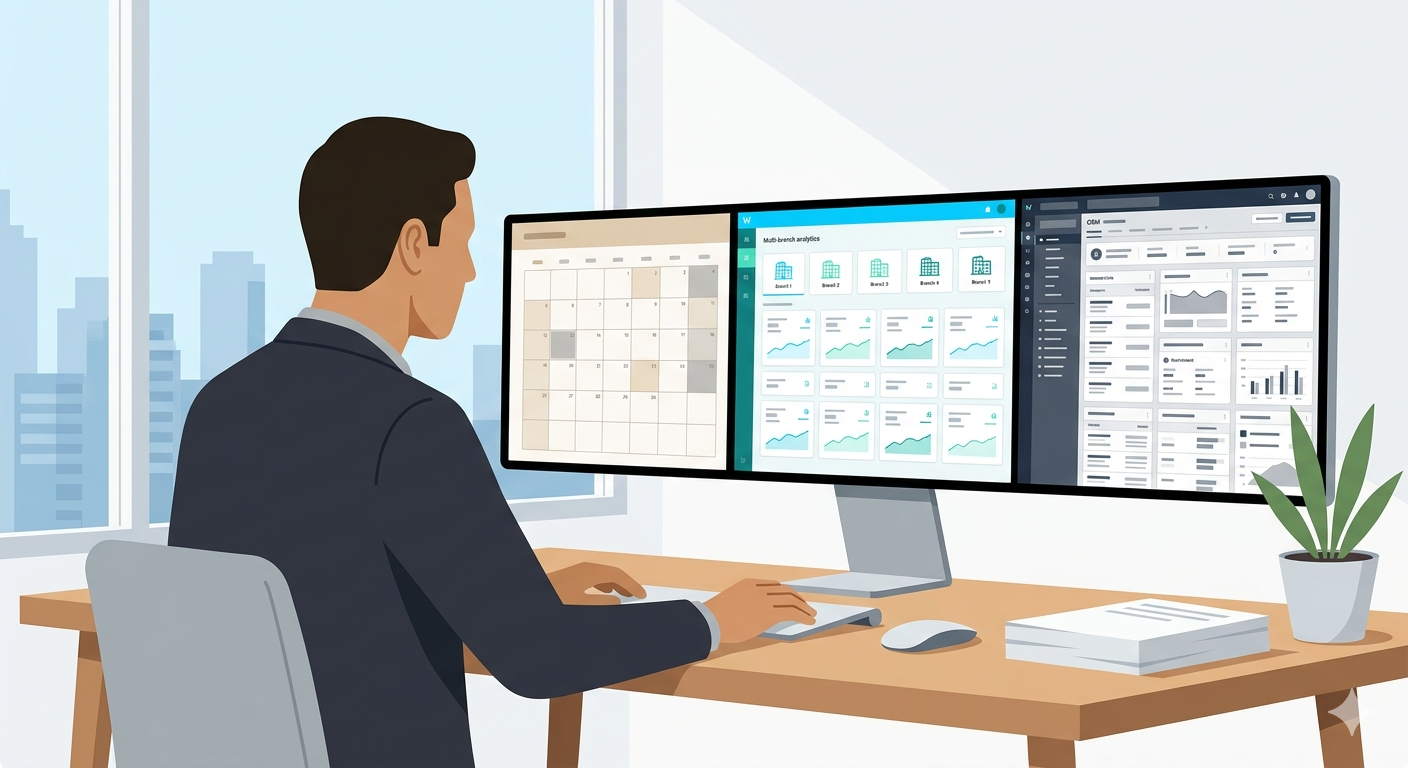
The limitations become visible as soon as the operation grows beyond a single location. Generic booking tools cannot manage multiple branches as separate entities within one system. They have no concept of a walk-in customer and no mechanism for merging appointment arrivals with an existing queue. Staff capacity maps to individual calendar availability, not to a service resource shared across a branch. Reports, if they exist, cover one calendar at a time.
For a branch manager responsible for ten locations, a generic booking tool creates more administrative work than it removes. Each branch requires its own setup, its own management, and its own reporting. The consolidation that makes a multi-branch operation manageable does not exist.
Where it works well
Freelancers, consultants, therapists, and single-location service businesses where one operator manages one calendar and walk-in customers are not part of the equation.
What is a Branch-Integrated Scheduling System?
A branch-integrated scheduling system is purpose-built for multi-location service operations. It handles the complexity that generic tools cannot: multiple branches running simultaneously, walk-in and appointment customers arriving through the same door, staff availability varying by location, and management needing visibility across all of it.
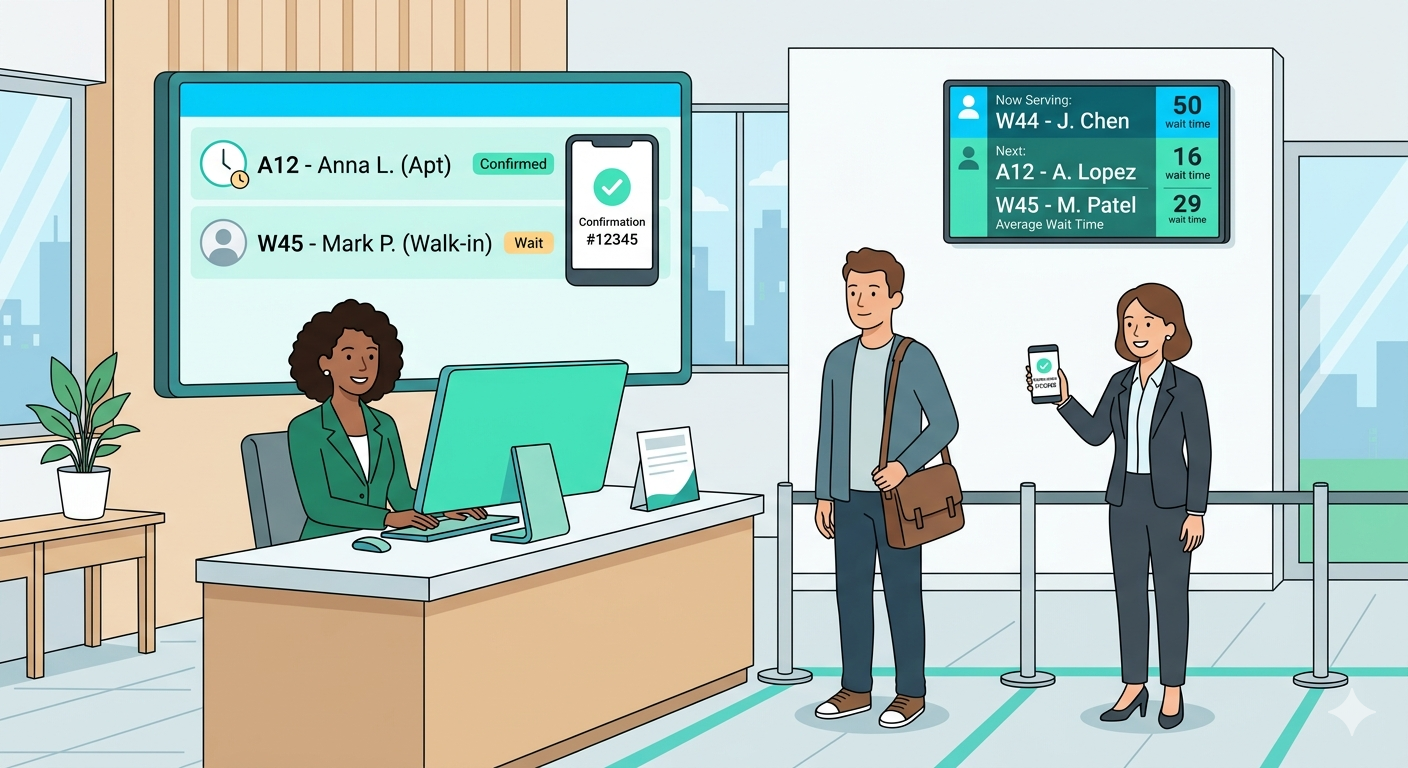
The defining characteristic of this system type is integration between scheduling and queue management. Booked appointments do not exist in a separate system that staff have to check separately. They feed directly into the live queue alongside walk-in customers. Staff work from one interface. Branch managers see one consolidated view of their day: who is booked, who has arrived, and what the current wait looks like, both before the day starts and as it unfolds.
How integration changes the working day
This integration is what makes workload distribution possible in practice. When a booked customer arrives, the system places them in the queue at the correct priority without any manual intervention. If a customer cancels through their reminder message, the system releases the slot automatically. Appointment uptake data across all branches stays in one place, so regional managers can compare locations without chasing separate systems.
Research from major operations consultancies suggests that service operations integrating scheduling with real-time resource management consistently outperform those that treat them as separate functions. In a branch context, that integration is the difference between a scheduling system that changes how the day runs and one that adds a booking page without changing anything else.
Where it works well
Regional managers responsible for multiple branch locations where walk-in and appointment customers must be served together, and where workload distribution across the working day is the operational priority.
What is Enterprise CRM-Integrated Scheduling?
Enterprise CRM-integrated scheduling is not a standalone system. It is a scheduling module that sits inside a broader customer relationship management platform, such as Salesforce, Microsoft Dynamics, or Oracle Service Cloud. Scheduling in this context is one capability among many, alongside customer history, case management, sales pipeline tracking, and service contract management.
The strength of this type is depth of customer data. When a customer books an appointment, the system can surface their full relationship history: previous interactions, open cases, contract status, and communication preferences. For relationship-heavy service environments where the appointment is the start of a longer managed process, that context is valuable.
The tradeoffs are significant. Enterprise CRM platforms are expensive, implementation takes months rather than weeks, and configuring them to model a multi-branch service operation is substantial work. These platforms center on the customer relationship, not on branch throughput. Walk-in customer management, queue integration, and real-time branch workload distribution are typically afterthoughts, if they exist at all.
For most branch operations, the result is a system with far more capability than the operation needs, in areas that are not relevant to daily service delivery, and gaps in the areas that matter most.
Where it works well
Large financial institutions, insurance companies, and organizations where appointments are part of a long-term managed customer relationship and the scheduling system needs to connect to a full customer history and case management workflow.
Key Takeaways: Types of Appointment Scheduling Systems
What the operation actually needs determines the right type of appointment scheduling system, not which system has the most features. Generic tools are fast and simple but they cannot manage multiple locations. Enterprise CRM platforms are powerful but they target relationship management, not branch throughput. Branch-integrated systems address the specific problem that multi-location service operations face: distributing demand, managing walk-ins and appointments together, and giving managers visibility across every location from one place.
| System Type | Built For | Main Limitation for Branches |
|---|---|---|
| Generic booking tools | Individuals and single-location businesses | No multi-branch support, no walk-in integration |
| Branch-integrated systems | Multi-location service operations | None for this use case |
| Enterprise CRM-integrated | Relationship-heavy, long-cycle service environments | Complex, expensive, no native support for branch throughput |
A generic booking tool handles reservations for a single location or individual. It does not connect to a queue, cannot manage walk-in traffic alongside appointments, and has no visibility across multiple branches. A branch scheduling system is purpose-built for service operations: it integrates appointments into the live queue, balances demand across locations, and gives staff a single view of both booked and walk-in customers.
Yes. Branch-integrated scheduling systems are designed for hybrid queues: appointment holders receive a reserved slot, while walk-ins are served in the available windows between them. Walk-in service does not stop. The goal of appointments is to distribute demand more evenly across the day, not to replace unplanned visits.
A branch-integrated scheduling system. Generic tools lack multi-location management, and enterprise CRM platforms are built for relationship management, not service-floor operations. A branch-integrated system is designed specifically to handle multi-location scheduling, unified queues, and real-time visibility across branches from a single interface.
Only if your branches are already running a CRM that manages ongoing customer relationships, and if appointment scheduling needs to live inside that system. For most branch operations, a CRM-integrated platform introduces significant cost and complexity without adding operational value. Purpose-built branch scheduling systems handle the same scheduling and queue functions at a fraction of the overhead.
The reserved slot opens up and can be filled by walk-in customers waiting in the queue. In a well-configured branch scheduling system, no-show slots are released automatically and the walk-in queue absorbs the capacity without staff intervention.
It depends on the system. Branch-integrated scheduling platforms are typically built with queue management integration as a core feature, not an add-on. Generic booking tools and most CRM scheduling modules were not designed to connect to a physical service queue. If you already run a queue management system, the cleanest path is a scheduling module from the same platform or one with a documented integration.
Waqtak is a cloud-based queue management system built for multi-branch service organizations.

Alawneh Exchange Partners With Waqtak to Take the Wait Out of the Branch Visit
Waqtak and Alawneh Exchange have partnered to bring digital queue and appointment services to Alawneh’s customers across the…

Your Busiest Two Hours Are as Expensive as Your Quietest Six
At 10:30 in the morning, the waiting area is standing room only. Numbers have been called, customers are…
How to Choose an Appointment Scheduling System for Multiple Branches
Not every appointment scheduling system solves the same problem. A system built for a freelance consultant and a…
Want to see how this works in practice?
Book a personalized demo and we will walk you through how Waqtak closes these blind spots for an operation like yours.
Book a Demo